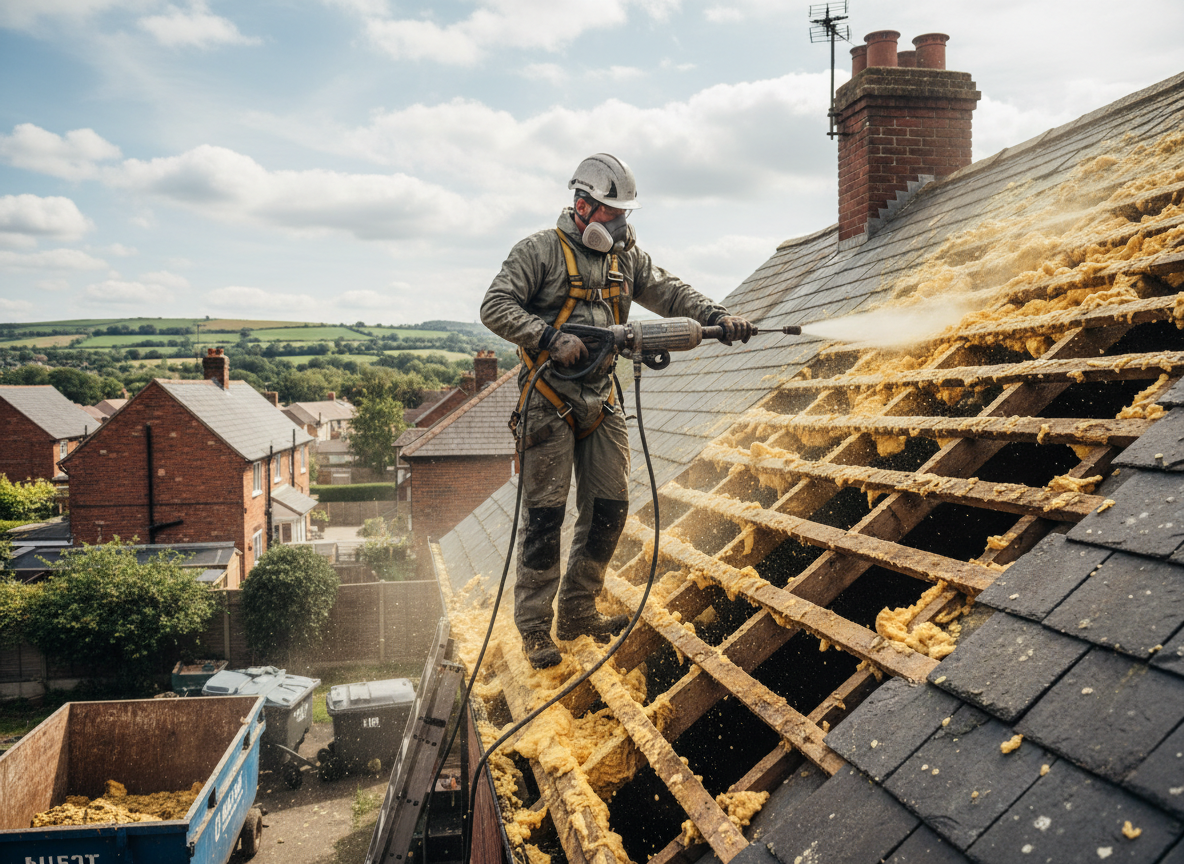
Telford's post-war new town estates often feature flat or low-pitch roofs coated with closed-cell polyurethane foam in the 1980s and 1990s. Over time this foam absorbs moisture through micro-cracks, leading to rot in the original asphalt or felt layer beneath. Removal requires careful mechanical scraping followed by solvent treatment to dissolve residue without compromising the timber decking common in Dawley, Madeley and Oakengates terraces.
Winter rainfall in the Telford area frequently exceeds 80 mm per month, so any exposed roof during removal must be protected immediately with temporary sheeting. We work in short sections, clearing foam down to the substrate before moving on, to prevent water ingress into bedrooms below. Older properties around Hollinswood Road often have additional layers of mineral wool that must be separated and disposed of separately under current waste regulations.
Edge cases include foam that has been applied over existing tiles on pitched roofs in Ketley and Wellington; here we use infrared scanning to locate voids before cutting. Homeowners sometimes attempt DIY scraping, which leaves bonded patches that later cause blistering when new coverings are installed. Proper removal restores the roof to a clean, inspectable surface ready for traditional felt or modern membrane systems.
We schedule most jobs during drier spring and autumn windows because prolonged wet spells can extend drying times for the deck. All waste foam is bagged on site and taken to licensed Shropshire facilities rather than left in skips that attract fly-tipping fines in residential streets.
Technician insight
In Telford the thing that catches most people out with roof spray foam removal is the 1960s concrete decking on many Hollinswood and Malinslee properties. The foam bonds so tightly that aggressive scraping can crack the deck, letting rainwater straight into bedrooms below. We always check for that before we start.
Flat Roof Foam Stripped in Dawley
A 1970s flat roof on a Dawley semi had two layers of closed-cell foam trapping water against the original felt. We found soft spots along the joists during inspection. After sectional removal and solvent clean the deck dried out fully and the owner fitted a new GRP membrane without further issues.
How it works
- 1
Site Assessment
We inspect the roof from above and inside the loft, checking for rot, previous repairs and the thickness of the foam layer across Telford properties.
- 2
Protection and Access Setup
Scaffolding and roof sheets are positioned to shield gardens and interiors while giving safe access on the often slippery foam surfaces found on Shropshire roofs.
- 3
Mechanical Removal
Powered scrapers and hand tools strip the bulk foam down to the original substrate, working in controlled sections to manage dust and debris.
- 4
Residue Treatment and Final Clean
Solvent application dissolves remaining bonded foam, followed by brushing and vacuuming so the roof is left ready for new coverings.
Pricing
Cost depends on roof size, number of layers and access difficulty; we provide upfront quotes after inspection.