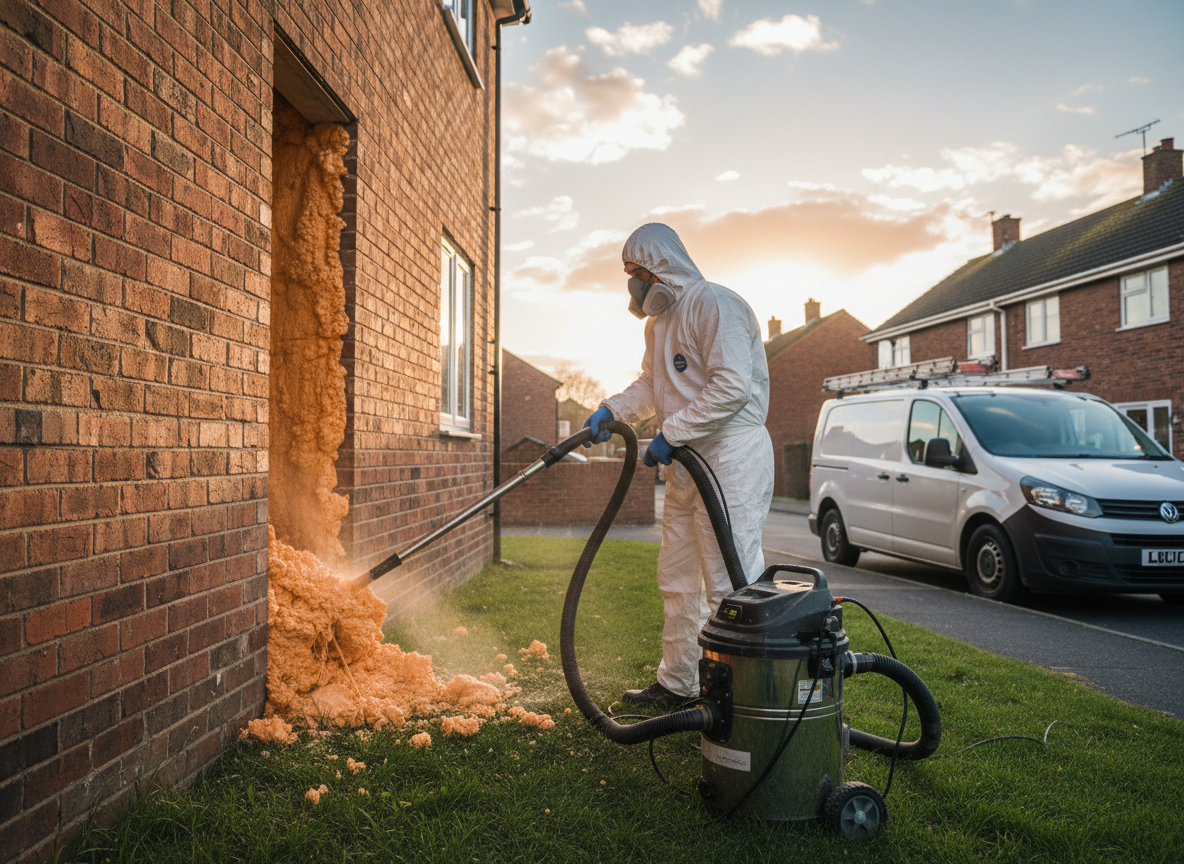
Cavity wall spray foam installed in Telford estates from the 1970s onward often breaks down when moisture enters the brickwork. Shropshire winters bring prolonged rain that soaks through mortar joints on exposed elevations, turning the foam into a sponge that holds water against the inner leaf. Homeowners notice cold spots on gable ends and musty smells in bedrooms above the damp-proof course. Full removal requires drilling at staggered centres, vacuum extraction of the degraded material, and inspection with an endoscope to confirm no residue remains in the narrow 50 mm cavities typical of local Wimpey and Wates builds.
Edge cases appear on properties near the Ironbridge gorge where wind-driven rain hits harder. Foam bonded to wall ties must be cut free rather than pulled, otherwise the ties twist and compromise the outer leaf. We also see cases where previous installers injected foam over existing mineral wool, creating a layered blockage that traps condensation. In these situations the cavity is opened at the base, the mixed debris is raked out, and the void is left ventilated until the walls dry. Local building control sometimes requires a notice when the work affects the thermal performance of the property.
After extraction we fit new weep holes at 450 mm centres and check for bridged cavities at window reveals and meter boxes. Telford’s clay subsoil holds water longer than free-draining ground, so we advise owners to delay re-insulation until moisture readings drop below 15 percent. Skipping this step leads to rapid re-contamination of any new material. The job finishes with a written report noting cavity width, residual foam percentage, and recommended drying time before further works.
Technician insight
In Telford the thing that catches most people out with Cavity wall spray foam removal is the clay-heavy soil around estates like Dawley and Madeley. It keeps the lower courses wet for months, so foam at the base of the cavity never dries and homeowners think the job is finished when it is only half done.
Gable End Failure on a 1970s Semi
A homeowner in Hollinswood reported persistent damp on the bedroom gable. We found the cavity packed with waterlogged foam from an old injection job. Extraction revealed the foam had bridged the wall ties and trapped moisture against the inner blockwork. After clearing the void and adding extra weep holes the walls dried and the mould stopped returning.
How it works
- 1
Site Survey and Moisture Mapping
We attend the Telford property, drill test holes, and use a moisture meter to map affected areas in the cavity.
- 2
Controlled Extraction
Staggered access holes are drilled and industrial vacuum equipment removes the foam without damaging wall ties or brickwork.
- 3
Cavity Inspection and Clearance
An endoscope checks for remaining material, especially around reveals and floor joists common in local 1970s homes.
- 4
Ventilation and Drying
New weep holes are installed and the cavity is left open until walls reach acceptable moisture levels before any new insulation.
Pricing
Cost depends on property size, cavity depth, and how much foam has bonded to the brickwork; we provide a clear quote after the survey.