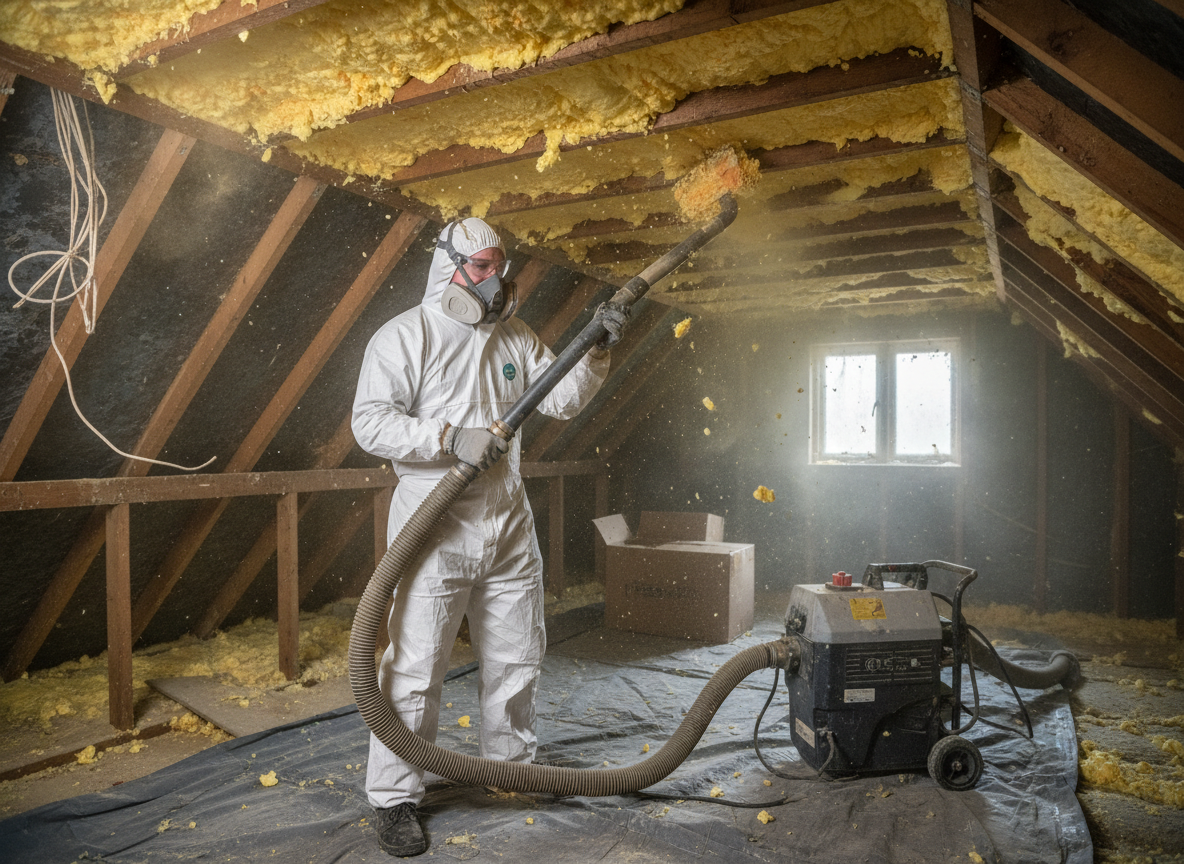
Telford's post-war housing stock in estates like Hollinswood and Dawley often received spray foam in the 1990s and early 2000s to meet energy targets. Over time the closed-cell material traps condensation against rafters, especially where ventilation is poor in the Shropshire climate of frequent rain and mild winters. Removal requires careful cutting and vacuum extraction to avoid damaging original timber or releasing fibres into living spaces below. Homeowners in terraces near the old ironworks sites frequently discover the foam has bridged eaves, blocking airflow and creating rot that only appears once ceilings are opened.
Work in these attics demands protection for existing electrics and pipework common in 1960s-1980s builds. Crews must assess whether the foam was applied over original mineral wool or directly to felt, as the latter leaves residue that needs solvent treatment before new insulation can go in. Local planning rules in conservation areas around Ironbridge also require documentation that any replacement meets current U-values without altering roof profiles. Skipping this step risks later enforcement notices when properties change hands.
Access through small loft hatches in many Telford semis means equipment must be broken down and passed up piece by piece. Dust containment is critical because older properties have shared party walls that carry sound and particles between homes. After removal, the team checks for hidden damp in ridge and valley timbers before advising on breathable alternatives suited to the area's variable humidity.
Technician insight
In Telford, the thing that catches most people out with Attic spray foam removal is the way 1970s estates around Hollinswood trap moisture against rafters because the original felt underlay never breathed properly once the foam went on. Homeowners assume a quick scrape will sort it, but the closed-cell material bonds so tightly that solvent and mechanical removal are both needed or you leave pockets that cause rot later.
Hollinswood Terrace Attic
Foam installed in the 1990s had bridged the eaves in a 1960s semi, causing black mould on bedroom ceilings after heavy autumn rain. Inspection showed saturated timber at the wall plate. We extracted the foam in sections, cleaned residue, restored airflow and left the loft ready for new insulation without further decay.
How it works
- 1
Site Assessment
Inspect attic access, foam type, timber condition and any electrical or pipe runs in Telford properties.
- 2
Containment Setup
Seal loft hatch and install negative air to prevent dust migration into living areas below.
- 3
Foam Extraction
Cut and vacuum material in sections, treating residue on rafters where needed.
- 4
Clearance and Check
Remove debris, inspect for damp or rot, and confirm ventilation paths are restored.
Pricing
Cost depends on attic size, foam depth and access difficulty; quotes provided after inspection.